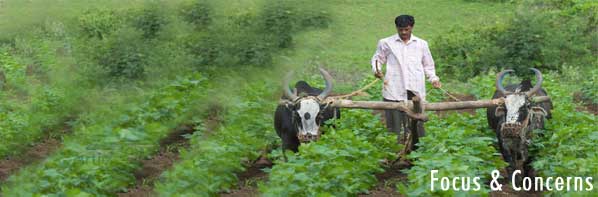
Gender, understood in its diversity and natural resources is a core pillar of SOPPECOM's work. The objective of the programme is to encourage, participate in and support interventions that can help bring gender concerns to the centre of policy, practice and research in the area of Natural resource management, specifically land and water management. A dedicated team of researchers and activists from diverse socio-economic backgrounds through a model of collective leadership works on this core area through 1) field interventions and capacity building 2) feminist research, documentation and policy engagement 3) support to civil society groups and networks.
Following are the core areas of work
- Gender, water and sanitation
- Agriculture, land rights
- Agroecology
- Agriculture Labour
- Secretariat, Mahila Kisan Adhikar Manch (MAKAAM)
Gender, Water and Sanitation
Right to water for landless women in Khudawadi
SOPPECOM's first major initiative in this direction was a pilot action program, launched in the mid-nineties "Securing Livelihoods," aimed at establishing water rights for landless women in Khudawadi village, Osmanabad district of Maharashtra. This was achieved through negotiations with the Water Users Association (WUA) formed on a minor canal of a medium irrigation project called the Kurnur Medium Irrigation Project. These women, primarily single and working as agricultural wage labourers, were organised into a collective that negotiated for water rights to be used on leased land.
This program underscored the significance of water as a crucial means of production, highlighting the need to establish women farmers' rights over water. By securing water rights, these women could also gain access to land, an essential means of production in the rural context. This experiment significantly enhanced our understanding of gender and water issues, leading SOPPECOM to actively engage in policy dialogue on this matter. Consultations were held on including women farmers in the water policy and Participatory Irrigation Management Act that the State of Maharashtra was drafting. While the inclusion of women owning land in command areas on committees was accepted, the inclusion of landless women was not. SOPPECOM continues to engage with the government through its strong presence on the State Monitoring Committee of WUAs.
Enhancing Women Farmers' Participation in the Ghod Irrigation Project, Maharashtra
Continuing this work, SOPPECOM held discussions with the Water Resources Department of Maharashtra to involve women members of the managing committees of WUAs in the Ghod Irrigation Project. Over two years, the team trained more than 150 women committee members across 55 WUAs in the Ghod Irrigation Project.
Joint dialogues with male committee members and irrigation officials were conducted to encourage male-dominated irrigation societies to accept women's participation in decision-making. Despite irrigation being a male-dominated domain, post-training evaluations showed that women were gradually making use of available spaces in the WUAs. These trainings were later extended to Raigad district, where more than 50 women were trained as part of the program initiated by Shramik Kranti Sanghatana. Training manuals for Participatory Irrigation Management (PIM) and gender have been developed and shared with the Water Resources Department of Maharashtra.
Capacity Building of Water Sector Professionals and Students
In collaboration with SACiwaters, SOPPECOM has extensively trained staff, students, and mid-career professionals in universities and NGOs on the issue of water and equity. SOPPECOM has been closely associated with the Water Policy and Governance course at Tata Institute of Social Sciences in drafting the course and delivering lectures.
These trainings mainly aim to introduce a feminist perspective to the water sector. Current policies and practices often overlook the social dimensions of water conflicts. The trainings emphasize the need for a thorough analysis of the constraints on women's access to water, considering social structures, gendered labour division, social norms, identities, and the unequal distribution of social, political, and economic privileges. Additionally, the intersectionality of caste, religion, and tribe with gender is also addressed to provide a comprehensive understanding of these issues.
Feminist Research in Water
SOPPECOM has consistently reviewed new policies in the water sector from a feminist lens. Feminist research at SOPPECOM aims to construct new forms of understanding and knowledge while driving social change. This research, informed by women's struggles against oppression and rooted in feminist values, provides a gendered understanding of issues like irrigation, agriculture, and land. By centring women irrigators, water users, and farmers in debates and policy discourse, SOPPECOM seeks to shift perspectives in these sectors.
In early 2000, the government introduced policies around decentralisation in the water sector. Its impact on women across diverse socioeconomic groups needed an examination. Studies on decentralization in the water sector revealed the need to incorporate gender and social justice questions into water and agriculture policies. Through the Social and Gender Equity Gauge (GEG), SOPPECOM developed an evaluation framework for assessing gender and social equity in the water sector. Fieldwork in 10 villages in Ahmednagar, Maharashtra, and several villages in Nepal highlighted the absence of women and marginalized groups from decision-making institutions in the water sector and their poor access to water.
Macro-level studies across South Asia also revealed the patriarchal nature of water bureaucracies that constrain highly qualified women engineers.
Through this program, women learned several skills, though success requires support from both the state and the family. The constraints became evident during the intensive work with the women's collective.
Transformations to Groundwater
Throughout India, the ever-increasing availability of affordable pumping technologies has drastically changed modes of accessing water, including in command areas of public irrigation systems. From relying on gravity flows that transport water through canal minors, sub-minors, outlets and field channels, many farmers now access water by pumping it either directly from canals or from wells. SOPPECOM along with ACWADAM did an in-depth study of farmer's practices in accessing, storing and using water in Ravangaon village of Maharashtra, which has sugarcane as its dominant crop.
Ravangaon is served by canal irrigation of Khadakwasla dam, apart from minor irrigation tanks located in the village. In Ravangaon, as in many other irrigated areas of Maharashtra, what farmers do, and why they do it, is importantly determined by the political economy of sugarcane. The study was situated in the broader conversation about conjunctive use and management of water. An article that discusses the findings from the study can be found here.
Gender and Sanitation
Closely linked with the question of water is an understanding of sanitation, the lack of which leads to a disproportionate share of the work burden for women. SOPPECOM has been involved in studies that look at sanitation vulnerabilities. In the sanitation sector, SOPPECOM investigated the vulnerabilities women face due to inadequate facilities in the urban slums of Pune, Jaipur, and Bihar, highlighting the violence and psycho-social stresses involved. A similar study was done in Bihar.
Towards Brown Gold Reimagining off-grid sanitation in rapidly urbanising areas in Asia and Africa.
Towards Brown Gold is a study across five sites in Asia and Africa to understand the off-grid sanitation question. The project duration is from 1st August 2020 to 31st August 2023, with an extension till September 2024. GCRF-UKRI funds the Project.
SOPPECOM's role is to look at marginality and gender in the city of Nanded Waghala. Nanded was chosen as it was cited as the best example of a Community-led total sanitation (CLTS) programme in Maharashtra. Institute of Development Studies (IDS) had done a study of that project when CLTS was being implemented. Thus, this project would allow us to revisit the city and its sanitation.
One of the articles on the sanitation situation of migrant workers has been published in PARI
Women and Land Rights
In India, 75 percent of female workers (and only 55 percent of male workers) depend on agriculture. For Maharashtra, this figure is 88 percent of all the female workers as against 66 percent of male workers (PLFS2020-21). Yet we see in official data (Agriculture Census 2015-16) that female operational holders are a mere 13 percent at the national level and about 15 percent in Maharashtra.
It is a well-documented fact that women contribute significantly to food production in India. Lack of land ownership significantly limits women's access to credit, water, and other resources that are required for food production.
The land rights program at SOPPECOM has evolved significantly from its work on operationalising women's right to water. In the process of operationalising women's right to water for agriculture, it became clear that lack of land ownership is a major barrier for women.
Since 2008, SOPPECOM has actively conducted scoping studies to understand the ground realities in Maharashtra concerning women's access to land. This included desk studies of existing literature and an examination of the work done by organizations working on obtaining land rights for women. Many of these organisations were supported by Swiss Aid, which implemented a programme to advance land rights for women using existing policies and legal instruments. These studies paved the way for a year-long consultation process across different regions of the state to identify key issues for women farmers in Maharashtra concerning access to land and other natural resources. The focus was specifically on women's ownership and access to land. However, several issues were brought to the fore in these discussions. These included women's lack of access to water, credit, agricultural inputs, forest rights, and harassment over Gairan (community lands) lands.
The regional talks culminated in a State-level consultation in 2016, where intensive deliberations led to the need for a network to work on women farmers' issues in Maharashtra that would connect with existing networks working with farmers, forest dwellers, fisherfolk, etc. Members from the National Women Farmers Network, The Mahila Kisan Adhikar Manch (MAKAAM), and the women and land rights network from Gujarat Working Group for Women and Land Rights (WGWLO) were invited to share their experiences, processes, challenges and achievements.
Property rights emerged as a critical issue in all five regions of the state, encompassing not only private property rights but also claims to public lands, forest lands, and ceiling surplus lands. This initiated SOPPECOM's journey to mobilize and form a broad network advocating for women farmers' rights across the state with a focus on land rights. However, the consultations also highlighted several issues of women farmers that emphasised that actions with women farmers cannot be limited to land rights alone.
While right over land is important, SOPPECOM's work has extended to include voice, recognition and importantly charting a pathway for socially just and ecologically sound alternative uses of agricultural land.
SOPPECOM in its publication of 2017 outlines the key issues with reference to women's access to land and other natural resources
Land rights and single women
From the early 2000 SOPPECOM has been looking at the question of land rights of women. Through its association with the Stree Mukti Sangharsh Movement in western Maharashtra, SOPPECOM's focus was on single women who were associated with the movement. A detailed study and testimonies of these women were done, especially looking at their property rights.
Studies on the livelihoods and concerns of single women in rural Maharashtra highlighted the extreme forms of deprivation on the one hand and also the agency to act and emerge as leaders in their own right.
Study on land lease practices
In September 2015, NITI Aayog set up an Expert Committee headed by Dr Tajamul Haque to examine the existing tenancy laws and to suggest appropriate amendments to meet the felt need around legalising agricultural land leasing and create a Model Agricultural Land Leasing Act for the benefit of State governments. The underlying assumption was that legalizing land leasing would increase agricultural efficiency, and occupational diversification, lead to rapid rural transformation and address equity issues. Maharashtra government followed suit and following the Model Land Lease Act introduced a bill to enact the law relating to Agricultural Land Leasing in the State of Maharashtra on 7th April 2017 in the Legislative Assembly.
Liberalising land leasing is a contentious issue and is likely to be opposed by tenants fighting for claims to land under the old tenancy laws. However, it also opens up some possibilities for groups leasing land for cultivation. The team specifically wanted to look at the potential of such a bill for leasing by women's collectives and whether it could ensure the security of tenure. An exploratory study in Osmanabad district, Maharashtra, examined current leasing practices and sharing arrangements to evaluate the potential of land leasing for women's collectives under the Model Agricultural Land Leasing Act. An article outlining the findings has been published in can be found in 'The Land question in Neoliberal India: Socio-Legal and Judicial Interpretations', Edited by Varsha Bhagat - Ganguly, published by Routledge India and in Marathi here
Action programme on women and land rights
In collaboration with the Women's Studies Centre at ILS Law College, Pune, SOPPECOM conducted intensive trainings for NGO staff, women farmers, and revenue officials at the village and subdivision levels. Approximately 300 women farmers and activists received training on the legal aspects of land rights and the processes to stake claims to land. SOPPECOM also engaged in dialogue with the revenue department, training around 250 village-level and subdivision-level revenue officials over the past year.
SOPPECOM and the ILS Women's Studies Centre also plan to recommend legal amendments and administrative mechanisms to secure land titles for women from marital and natal properties, as well as public lands.
Women's access to land
SOPPECOM is currently involved in a study to understand extent of women's land ownership in Maharashtra. The study aims to fill in the gap in the current knowledge around how many women own land, and further aims to explore profile of the women land owners in order to understand constraining and facilitating factors in women claiming their right over land. The study is being done in ten villages across five districts.
Gender and Agroecology
Intensive Cultivation on Small Plots in Khudawadi
In 1992, SOPPECOM facilitated the formation of a Water Users Association (WUA) in Khudawadi village of Tuljapur taluka in Osmanabad district. The WUA was formed on a minor Kurnur Medium Irrigation project canal. Sharing of water to a landless women's collective was agreed upon after several meetings with the members of the WUA. The women's collective in Khudawadi was formed to explore alternative farming methods that make optimal use of land and water. Guided by Prof. S. A. Dabholkar who initiated Prayog Parivar, a network of innovative farmers, the experiment focused on the principle that a small plot of ten gunthas (1/4th of an acre) can provide a prosperous life for a family of five. The approach emphasised on scientific resource management to optimise production in an ecologically sound manner. Key principles included harvesting sunlight, measuring water, and regenerating soil through organic inputs.
Documentation of agriculture practices of women farmers
Detailed documentation of various agricultural and water management practices employed by women and socially marginalized groups has provided new insights for SOPPECOM's field actions and advocacy. In 2017-18, the team documented farming practices followed by women farmers from diverse socio-economic backgrounds in Maharashtra. The innovative approaches in farming and water sharing in drought-prone districts offer pathways for climate-resilient agriculture and sustainable water use.
Ecologically sound self-reliant farming (ESSRF)
During the pandemic and soon after, SOPPECOM held several conversations with members of MAKAAM across different parts of the state to assess possibilities of making transitions towards agriculture models that emphasise food and nutrition security. The work started with encouraging women to set up kitchen gardens with local seed varieties. Similarly, ecologically sound options were being explored by MAKAAM associates working on the question of inland fisheries in the Vidarbha region. These experiences which can be read here, here and here provided important lessons for SOPPECOM to develop its programmes around Agroecology in the years to come.
SOPPECOM is currently working with over 200 women farmers in six districts of Marathwada and Vidarbha region to facilitate transition to ecologically sound self-reliant farming. The work is being done in collaboration with six associates of MAKAAM Maharashtra and a newly formed women's group called Paryavarnasnehi Svavlambi Shetkari Mahila Sanghatana (Ecologically sound self-reliant women farmers' organisation). The programme was initiated just after COVID-19 hit the world and access to food had become a concern. The programme started with 100 women in 2021 and has entered its fourth year now with over 250 women who are part of it. Niranjana Maru of Chetana Vikas has been providing the technical support for the programme. The reports and videos of this work provide further details.
Drought and Migrant Sugarcane workers
Every year, over a million people migrate from the drought-prone regions of Marathwada and northern Maharashtra during the sugarcane harvesting season, which lasts about four to six months. Typically, it is a couple, often husband and wife, referred to as Koyta (Sickle used for harvesting sugarcane), who undertake the labor. They can't leave their infants and young children behind, so the entire family migrates, including older school-going children who help care for the younger ones. They reside in temporary settlements near the sugarcane fields and factories.
Sugarcane cutting is a back-breaking occupation that involves not just harvesting cane but also tying cane bundles, loading, unloading, and transporting these to the factory. A couple, usually husband and wife, perform these tasks together. With pressure to deliver on time, the mukadam (contractor or middleman) insists that each couple meets daily targets of harvesting two tons of cane. Typically, the working day is 12-13 hours long, with an additional 4-5 hours devoted by women for unpaid work such as childcare, cooking, cleaning, and fetching fuel and water.
The factory owner dictates the timings; since profits are maximized when freshly harvested sugarcane promptly reaches the factory, women report being woken up at the unearthly hour of 3 a.m. to load the trucks, often at the cost of their health. None can afford illness since missing work incurs a fine, which is usually twice that of the wages earned. Menstruating and pregnant women thus continue to work despite the discomfort caused to them; some women work till the last hour of their pregnancy and deliver at the work site itself. Some start working within a short span of 3 to 15 days after delivery. Single women workers often suffer sexual harassment at the workplace and have to carry their young children around during work. A short film about women sugarcane cutters' experience could be seen here.
Despite these hardships, cane cutting has become a preferred source of livelihood due to persistent drought, agrarian crisis, and non-availability of employment opportunities in their villages. This forces people-primarily from Denotified and Nomadic Tribes, Dalits, and OBCs (Other Backward Classes)-to migrate to the sugar belt in western Maharashtra, such as Kolhapur, Sangli, and Satara districts, or sometimes as far as Karnataka, in search of work.
In 2019, a news report in the Hindu Business Line highlighted the rising numbers of unwarranted hysterectomies among women sugarcane cutters. Several networks and sanghatans working with rural women in Maharashtra came together and raised this issue with the government. The government was compelled to introduce some policies in favor of women sugarcane harvesters. However, their recognition and rights as independent workers were still out of the ambit of state policy.
Since then, MAKAAM has taken up the cause, working to organize and amplify the voices of women sugarcane cutters. SOPPECOM, which convenes the network in Maharashtra, has supported the women cane cutters in gathering evidence and presenting it to lawmakers, urging recognition and registration as workers and improvements in their social and economic conditions in cane cutting work. Supported by the Women's Fund for Asia, SOPPECOM has been facilitating the formation of a grassroots organization of women sugarcane cutters to advance their rights and improve their health conditions. Moreover, SOPPECOM has consistently furthered the dialogue for alternative livelihood options at the local level with the women migrants. Many of them are now moving away from sugarcane cutting to developing their small plots of land based on principles of agroecology.
Support to Civil Society Groups and Networks
Since its founding in 1991, SOPPECOM has supported social actions and mass movements through research, capacity building, and advocacy.
Many of SOPPECOM's founding members were actively involved in water rights and feminist movements before the organization was established. One of the main reasons for founding SOPPECOM was to support social actions and mass movements through research, capacity building, and advocacy efforts. Social movements often lack the resources for these activities due to their daily engagement in resistance struggles. Since its founding year, SOPPECOM has supported various civil society groups working with women farmers, single women, and water users in numerous ways.
Mahila Kisan Adhikar Manch
The team has consistently worked to bring together women's groups in rural Maharashtra under one platform to address issues faced by rural women farmers and labourers, focusing on their rights to land, labour, water, and forests. These women, mainly from smallholder or landless households, work as farmers, agricultural wage labourers, NREGA workers, and migrant workers in sugarcane cutting and brick kilns. Since the initiation of the land rights program in 2014, there has been a continuous effort to support smaller initiatives of women needing advocacy, research, and capacity building to facilitate the formation of grassroots collectives. Through SOPPECOM's efforts, a network around women and land rights began to take shape in 2015, which later became the Maharashtra chapter of the Mahila Kisan Adhikar Manch (MAKAAM).
As a continuation of this process, in 2018, SOPPECOM supported the nascent MAKAAM network to hold regional consultations in Marathwada and Vidarbha. In these two regions, the issues of drought and farmer suicides had constantly made women vulnerable. The consultations held in Nagpur and Aurangabad brought to the fore the stark problems faced by women farmers belonging to the farmer suicide households.
Action research was conducted following the consultations to analyse the women farmers from suicide-affected households. Various individual and organisational associates of MAKAAM gathered data. SOPPECOM provided the research support. The report was widely disseminated and shared by MAKAAM with the Government of Maharashtra. The GoM brought out a Government Resolution (GR) on 18 June 2019 in favour of women farmers from farm suicide-affected households. State Commission for Women took cognisance of the issue and assured prioritisation of the benefits of agriculture and welfare programmes for these women.
Around the same time, i.e. in June 2019, another simmering issue, that of women sugarcane harvesters, came up for discussion within the network. Hindu business line had reported a large number of unwarranted hysterectomies among young women sugarcane harvesters from the Beed district. For the last five years, SOPPECOM has been supporting the formation of women's sugarcane cutters organisation in Maharashtra. The details of this work are discussed under the section Women Migrant labourers.
This continued engagement with various individuals and organisations associated with MAKAAM has helped SOPPECOM build its programme for women farmers in the Vidarbha and Marathwada regions. After 2020, SOPPECOM agreed to provide Secretariat support to host the women farmers network.
To take the programme forward, capacity building of women farmer leaders was taken up in 2019 with the support of the Association of India's Development (AID).
In this phase, starting in 2019, 50 women were selected to lead the programme on ensuring entitlements for women from farm suicide households. Capacity building and hands-on training on land rights, MNREGA, Pension, Ration and Water rights was coordinated by SOPPECOM.
Several of these women are now leading some ongoing programmes where SOPPECOM provides support.
While recognition, voice and entitlements for women farmers form an important theme of the programme, the need for alternatives in the distribution and management of natural resources has been central to SOPPECOM's intervention. Since the last year, we have also started dialogue with young rural women regarding their livelihood concerns. An exploratory study and a photo essay on this issue have been completed. Interventions with this group of women would be taken up in subsequent years.
Currently, about 35 groups across Maharashtra are part of the MAKAAM network, with SOPPECOM providing Secretariat support. This includes working on policy and perspective documents, supporting research, and conducting capacity building.
In addition to supporting movements for land and water entitlements, the team is committed to exploring alternative models and pathways for ecological agriculture and livelihoods for women farmers. Climate change exacerbates existing inequalities, with women from the most vulnerable communities bearing the brunt. The material understanding of women and other marginalized communities around natural resources and their dependence on these for their livelihoods underscores the need to find ways to navigate the crisis. Recently, SOPPECOM held a consultation with women farmers in Vidarbha and conducted a brief study to understand women farmers' perspectives on climate change in Marathwada and coastal Maharashtra. The study and consultation findings highlight the impacts on women regarding labour availability, health, and food security, as well as the different ways women are responding to these changes.
MAKAAM Maharashtra Secretariat
Apart from specific programmes, SOPPECOM, as the Secretariat to MAKAAM Maharashtra, also supported the following activities. These are non-project activities
The following activities were conducted in the period between April 2022 and September 2023.
- Women farmers conference: On 7-8 May 2022, a state-level conference on the issues of women farmers was organised jointly with AFARM. As the Secretariat of MAKAAM, SOPPECOM was actively involved in the planning of the workshop.
- Periodic meetings with State Facilitation Team members and women leaders: Regular monthly meetings with women leaders are being conducted from April onwards for updates on the work being done by them with reference to addressing women farmers' issues around land, water, employment and access to social security benefits. Regular monthly meetings are conducted with the state-level facilitator team, which is represented by one or two associates from each district.
- Evidence gathering: In response to the inaction by the state government concerning the GR issued for women farmers, MAKAAM leaders planned to organise a conference in Mumbai during the monsoon session in June 2022. To support this activity, SOPPECOM supported the partners in gathering evidence regarding the outreach of the GR. An app-based survey design was prepared by SOPPECOM, and online training to gather data was also done in the first week of June. A meeting to discuss the findings and plan for the Mumbai event was organised with the women leaders on 17 June 2022 at BAIF. Due to the change in the Maharashtra government, the actual event did not take place.
- State-level conference of MAKAAM leaders: A state-level conference was held in November 2021 to prepare action plans for three years
- State-Level Conference of Women Farmers: A state-level conference of women farmers was conducted in Pune in October 2022 on the occasion of Women Farmers' Day. More than 100 women farmers from across the state participated in the two-day event. Women farmers deliberated upon various issues faced by them in the context of drought, increasing numbers of farmer suicides, dispossession from land, etc. An interesting session was organised around media representation of issues of women farmers. Senior journalists participated in the session and enriched the discussions. The report of the October parishad is available.
- Cash Transfer to substitute food grains: Just as the number of farm suicides is increasing in Maharashtra, the government introduced a GR in February of 2023, recalling the earlier GR of 2015, which extended the food grains at subsidised rates to farmers holding APL orange ration cards. Farmer families from 14 districts of Maharashtra will now receive cash instead of food grains. To assess the likely impacts of such a decision, SOPPECOM designed a survey with MAKAAM associates. The survey was conducted in nine of the 14 suicide-affected districts. The survey was administered with women farmers who emphatically stated that they do not want cash and want food grains through PDS. The reasons for this have been outlined in the article that was published on 22 July 2023 in Chaturang Loksatta.